
On the crockery sitting in most thoughtful Indian homes right now — and what it quietly says about how we live
There is a good chance you own a dinner set you did not think very hard about.
Not because you are careless. You are reading this, which suggests the opposite. But crockery is a category most of us approach the same way: a store visit, a set that looked right, a price that seemed reasonable, and a decision made before the questions were formed.
Perfectly fine. That, quietly, is the problem.
This piece is not an argument against those choices. It is an invitation to ask — for the first time, or more carefully than before — what the material on your table actually is, where it came from, and what a different choice might feel like. Specifically: what a piece of handmade ceramic crockery, the kind made in a place like Khurja in Uttar Pradesh, offers that the lifestyle store alternative does not.
I
INTEGRITY – SAND
Does your crockery tell the truth about what it is?
Pick up a piece of opalware and look at it carefully. It is smooth, bright white, and perfectly uniform. Every piece in the set is identical — same weight, same thickness, same surface. It is, in material terms, a form of glass: opacified with minerals, moulded under pressure, designed for maximum consistency. It does not come from clay. It has no relationship with earth.
Bone china — the aspirational choice in many Indian homes — is more complex but not more honest. The material is industrially processed, the forms are cast in moulds, and the surface decoration is applied by machine. The object is whatever the factory decided it should be, and it looks exactly like everything else from the same factory.
Integrity in an object means the absence of a gap between what it appears to be and what it actually is. Most lifestyle store crockery has that gap. A handmade ceramic piece, at its most honest, does not.
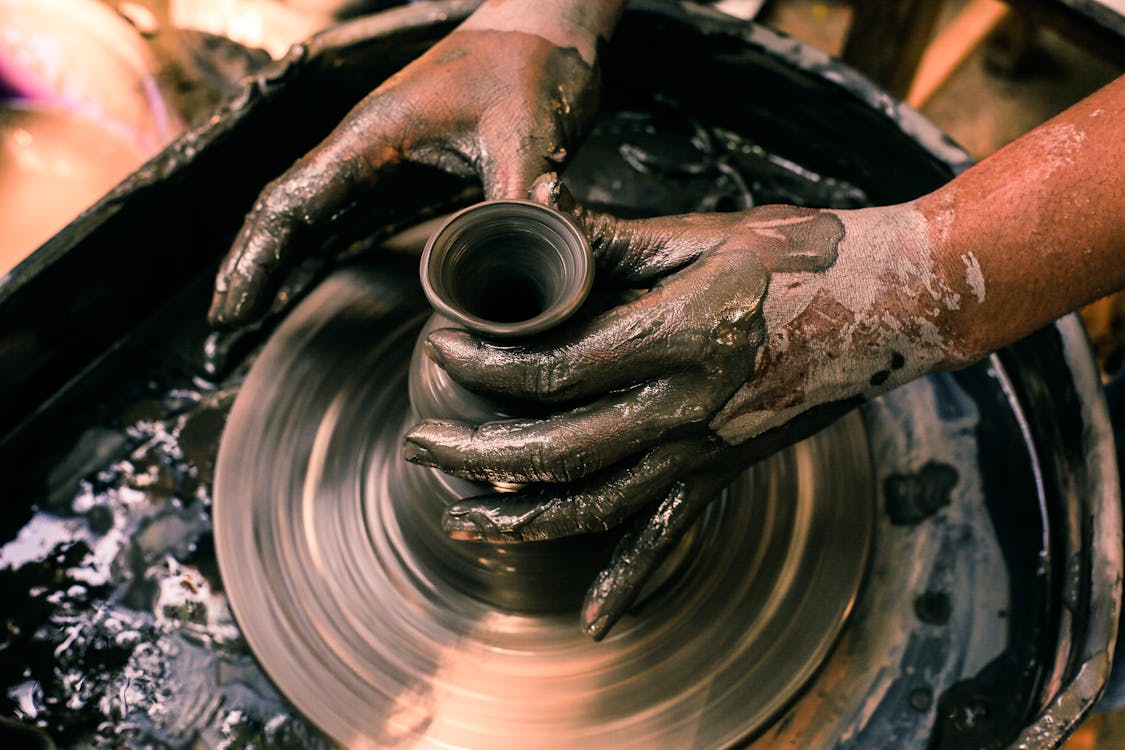
A handmade Khurja ceramic bowl is different in a specific way: it is what it appears to be. The clay body — a mixture of local white earth, feldspar, and quartz — is shaped by hand or on a wheel, fired at 1200°C until the quartz vitrifies within the clay itself. The surface quality is not applied. It is structural. The slight variation from piece to piece is not a styling choice. It is evidence.
II
TRADITION – CLAY
What does this object remember?
The opalware set, the bone china dinner service, the stoneware from a mall lifestyle store — these are all products of the 20th century, in design if not always in material. They were developed for industrial production, for consistency across thousands of units. They carry no specific memory of place, of community, of accumulated knowledge.
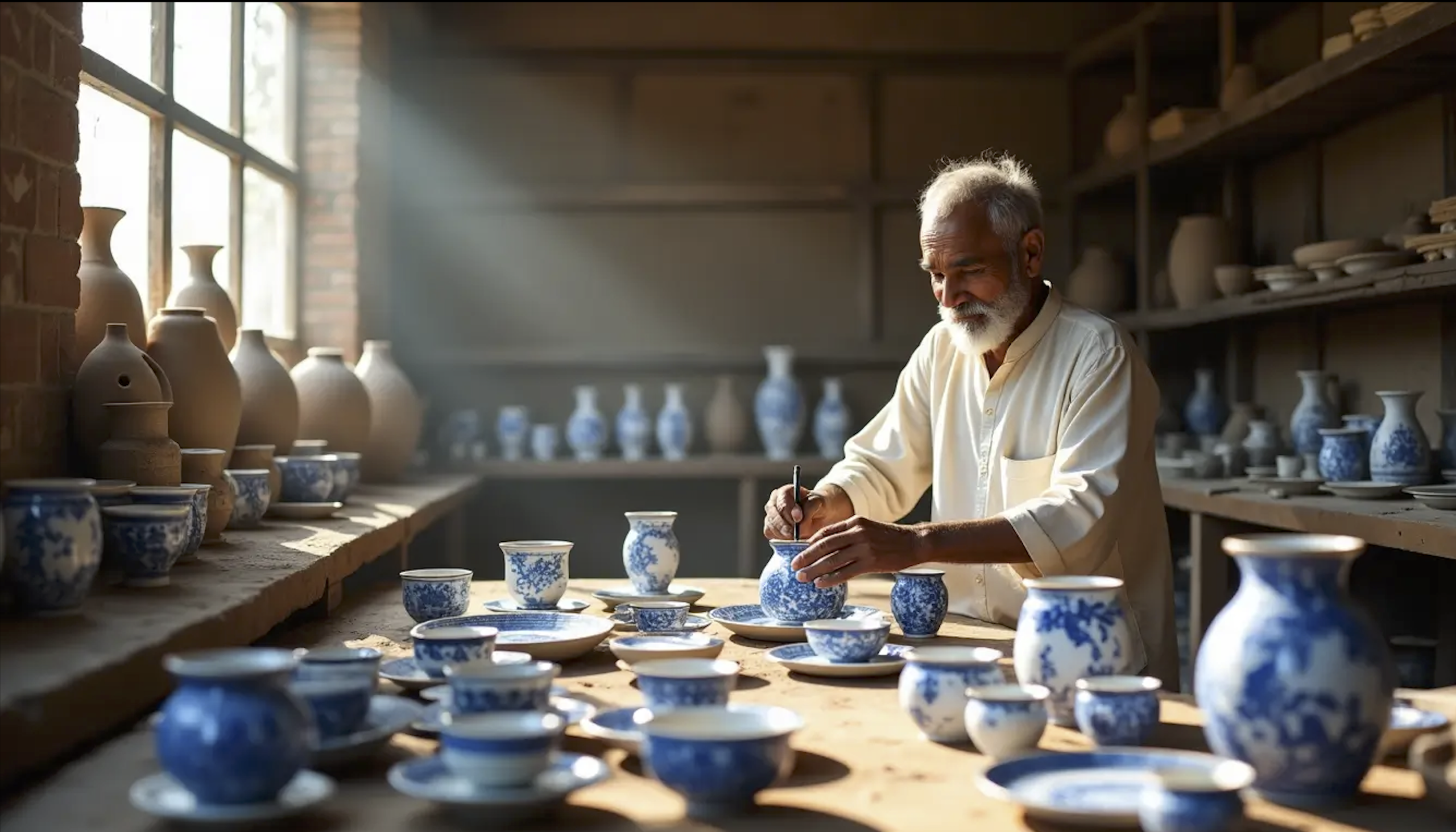
Khurja has been making glazed ceramic crockery for at least six hundred years. The tradition traces its origins to craft lineages that arrived with the Mughal courts — potters who brought techniques of underglaze painting, specific knowledge of clay bodies and mineral glazes, forms evolved for Indian cooking and eating. That knowledge was not written down. It passed through hands — from master to apprentice, parent to child, across generations.
When you eat from a piece of Khurja crockery, you are eating from the residue of accumulated judgment. The form of the bowl was not decided by a product designer. It evolved, over centuries, toward the shape that worked.
A handmade Khurja ceramic bowl is different in a specific way: it is what it appears to be. The clay body — a mixture of local white earth, feldspar, and quartz — is shaped by hand or on a wheel, fired at 1200°C until the quartz vitrifies within the clay itself. The surface quality is not applied. It is structural. The slight variation from piece to piece is not a styling choice. It is evidence.
III
MINIMALISM – AIR
Does this object belong in your life, or was it produced into it?
Indian lifestyle stores are very good at making crockery feel like a considered choice. The sets are curated, the materials are named, the styling is thoughtful. But the economics of a dinner set work against minimalism in a specific way. Sets are produced in quantities. They are marketed as complete solutions. They are replaced when they chip or the style shifts or a new collection arrives in store.
Minimalism, as BARL understands it, is not an aesthetic. It is a relationship with objects — choosing fewer things, but ones that genuinely earn their place. One handmade bowl used daily for a decade is more minimalist in spirit than ten matching opalware pieces that come and go with the trends.
IV
MINDFULNESS – WATER
What does eating from this object feel like?
There is a difference between an object designed to feel considered and an object that is considered. The former is a surface quality — a finish decision made in a design studio. The latter is something you notice over time, in use, not at the moment of purchase.
A handmade ceramic cup has a warmth that fired clay holds differently from processed glass or moulded porcelain. The slight spiral visible inside a thrown bowl is the record of the potter’s hands moving upward. These details are not noticed all at once. They are noticed gradually, over many uses, which is how mindfulness actually works — not as a moment of heightened attention, but as the accumulation of small noticings over time.
The opalware plate asks nothing of you. The handmade ceramic bowl stays present in the hand.
V
SUSTAINABILITY – ORGANIC MATTER
What is the true cost of the material you chose?
Opalware is glass. Its production requires high-temperature industrial furnaces, significant energy, and a manufacturing process with no meaningful connection to local materials or labour. When it chips or breaks, it goes to landfill. It does not return to the earth.
Khurja ceramics, particularly from smaller traditional producers, offer a different material story. The clay comes from the earth. The production, at its most traditional, is at human scale. The object, at the end of its life, is mineral matter. A handmade ceramic bowl made by a traditional producer, used daily for twenty years, has a fundamentally different relationship with the earth than a lifestyle store dinner set bought, used briefly, and replaced.
A different way to begin
None of this is an argument for replacing what you already own. That would be its own kind of waste, and waste is precisely what rooted living resists.
It is an argument for what comes next. When the next piece breaks or simply needs replacing — before going back to the same lifestyle store — ask the questions that this framework asks. What is it made of, and is it what it claims to be? Who made it, and what knowledge did they bring to it? Does it ask anything of you when you use it?
A handmade ceramic bowl from a place like Khurja answers these questions differently — not perfectly, but honestly. And honesty, at the table as elsewhere, is where a more rooted life tends to begin.